Tool-Loop Agent
An agent that calls tools, with no tool loop of its own. Rig Agent
and MCP Agent each write their loop over rig-core. This one
writes none: ToolLoopExecutor runs the SDK's ToolLoop over
OpenAiChatModel, and the agent is two tools (list_services,
service_status), a preamble and an agent card. Besides tokio and
serde_json, its only dependency is a2a-protocol-sdk with the tool-loop
feature (see
ADR 0022).
It is the example of the SDK's own tool loop; the
Tool Loop guide explains the loop itself.
Source: examples/tool-loop-agent/
What it shows
- A tool-calling agent built from
ToolLoop::new(model, tools),with_preambleandToolLoopExecutor::new, served like any other executor. - Recovery from a tool error inside one A2A task: the default question names a service the inventory does not have.
- Two artifacts per answer:
answer, what the model said, andtool-trace, what the tools returned. - A client that streams, because a blocking send can outlast the server's idle timeout.
Run it
You need an OpenAI-compatible chat endpoint serving a tool-capable model:
llama.cpp's llama-server, vLLM, Ollama or a hosted API. With llama-server,
--jinja is required, or no model emits a tool call (see
Rig Agent).
llama-server -m qwen3-1.7b-q4_k_m.gguf -c 8192 --port 8080 --jinja
TOOL_LOOP_BASE_URL=http://127.0.0.1:8080/v1 \
  cargo run -p tool-loop-agent -- "How is the billing service doing?"
A run serves the agent over JSON-RPC on an ephemeral loopback port, asks it one
question with the A2A client, prints the answer and tool-trace artifacts,
and exits non-zero unless the task completed. With no question on the command
line it asks "How is the billing service doing?".
| Variable | Default |
|---|---|
TOOL_LOOP_BASE_URL | http://127.0.0.1:8080/v1 |
TOOL_LOOP_MODEL | qwen3:1.7b |
TOOL_LOOP_API_KEY | none; sent as Authorization: Bearer when set |
TOOL_LOOP_THINKING | unset: each request carries "chat_template_kwargs": {"enable_thinking": false}; 1 sends nothing extra |
TOOL_LOOP_MODEL_TIMEOUT_SECS | 120, OpenAiChatModel's default: how long one model turn may take |
TOOL_LOOP_EXTRA_BODY | none: a JSON object merged into every request (sampler, seed) |
The standard OTEL_* variables turn on the SDK's Telemetry: the server's
call span, the executor's invoke_agent span, a chat span per model call and
an execute_tool span per tool call. With no endpoint set, nothing is built.
cargo test -p tool-loop-agent needs no model. It plays the billing run with a
scripted ToolModel through the same server, client and tools.
What you'll see
The README records a live run on 2026-10-20: llama.cpp llama-server build
b11751, qwen3:1.7b (Qwen3-1.7B Q4_K_M), four shared CPU cores, ten runs of
each prompt with thinking off. Abridged:
| Prompt | Completed | Tool calls | Answer |
|---|---|---|---|
| billing (unknown name: two rounds) | 10 of 10 | 10 of 10 called service_status("billing"), read the error, then called list_services | 10 of 10 named the three services and said billing is not among them |
| checkout (one call) | 10 of 10 | 10 of 10 called service_status("checkout") once | 10 of 10 gave the state and version 2.8.0; the uptime was right (259200 s) in 3, a number the tool never returned in 6, and converted wrongly in 1 |
No run hit the turn bound, and a run took 14 to 104 s. One transcript of each,
verbatim from the README (the program prints model:, agent: and asked:
lines before these):
state: TASK_STATE_COMPLETED
[ answer ]
The services in the inventory are: payments-api, checkout, search. The billing service is not listed among them.
[ tool-trace ]
service_status({"service": "billing"}) -> error: no service named 'billing'; call list_services for the inventory
list_services({}) -> ["payments-api","checkout","search"]
state: TASK_STATE_COMPLETED
[ answer ]
The checkout service is in a healthy state. Its current version is 2.8.0, and it has been running for 7200 seconds (2 hours).
[ tool-trace ]
service_status({"service": "checkout"}) -> {"service":"checkout","state":"healthy","uptimeSeconds":259200,"version":"2.8.0"}
Why there are two artifacts
The second transcript is the reason. The answer is fluent and its uptime is invented; the trace line beneath it shows what the tool returned (259200 s, three days). Six of ten checkout answers did this, against the preamble's instruction to report values exactly as returned. Counts that small say what those runs did, not a rate; the point is that the trace is there to be read.
Key code
The whole agent is a ToolLoop handed to ToolLoopExecutor, from
serve_agent in src/main.rs. It is shown as text because the book's doctests
do not build the tool-loop feature:
let tool_loop = ToolLoop::new(model, tools::catalogue()?).with_preamble(PREAMBLE);
let handler = Arc::new(
    RequestHandlerBuilder::new(ToolLoopExecutor::new(tool_loop))
        .with_agent_card(card(&url))
        .build()?,
);
let server = Server::bind(addr).await?;
tokio::spawn(server.serve_with_shutdown(JsonRpcDispatcher::new(handler), std::future::pending()));
Each tool implements Tool: a name, a description, a JSON Schema for its
parameters, read_only, and call. An Err(ToolError::Failed(…)) from call
goes back to the model as that call's result, not as a task failure, so
service_status writes its error for the model to read. For an unknown name it
says "no service named '…'; call list_services for the inventory", which is
the hint the model follows in the first transcript.
Sharing one provider between loops
Every task runs its own loop, so a swarm of tasks can send more turns at once than a provider serves. Two opt-in pieces bound that (ADR 0048):
let limit = InferenceLimit::new(4); // at most 4 turns in flight, across every loop
let model = LimitedModel::new(OpenAiChatModel::new(base, name)?, &limit);
let tool_loop = ToolLoop::new(model, tools::catalogue()?)
    .with_model_retry(ModelRetry::new()); // a 429 is sent again, not a failed task
A turn the provider refuses with 429 is ModelError::RateLimited, carrying its
Retry-After. Without with_model_retry it ends the run and the task fails as
transient, as before. With it, the loop waits the provider's delay (spread by
up to a quarter) or a doubling backoff from 0.5 s, at most three times by
default, and never longer than max_delay or what remains of the task's
budget. While it waits it holds no InferenceLimit slot. Other statuses are
not retried in the loop. The limit is per process; a fleet needs a gateway.
How it fits together
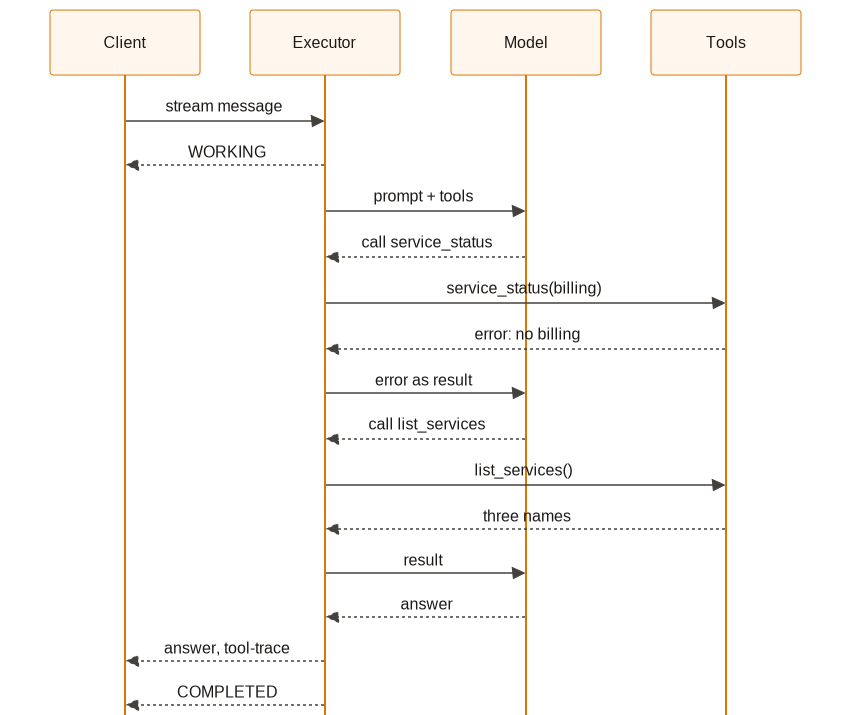
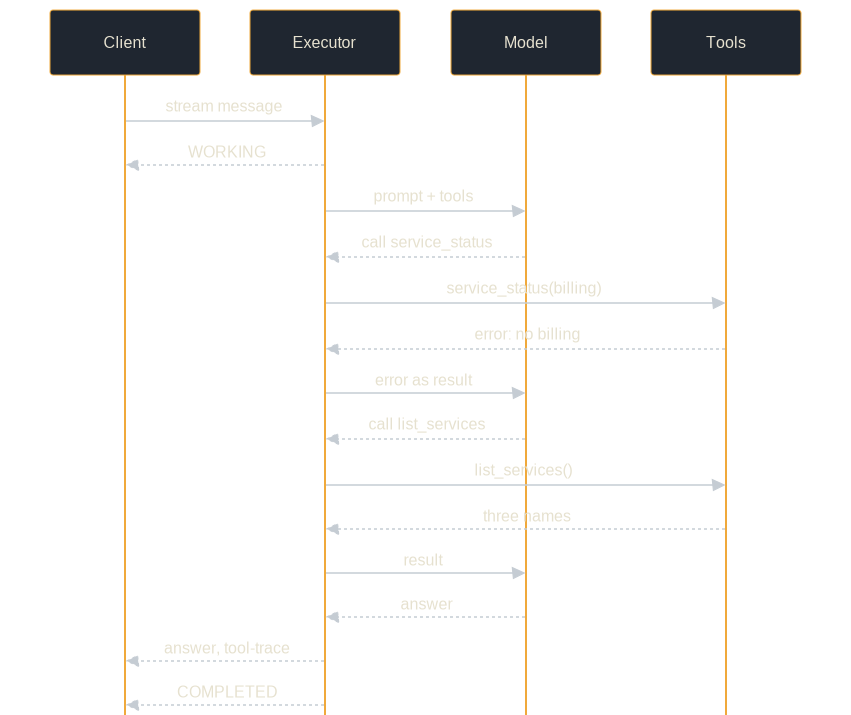
Every model turn and tool call happens inside one A2A task. The caller sees
WORKING, the answer artifact, the tool-trace artifact (when at least one
tool ran) and COMPLETED. The loop is bounded: ToolLoop allows 8 turns by
default (DEFAULT_MAX_TURNS), and a run still calling tools at the bound fails
the task with failure class budget-exhausted.
Why the client streams
A blocking SendMessage moves no bytes until the run is over, and the server
closes a connection idle for 75 seconds (DEFAULT_IDLE_TIMEOUT). A model turn on
a small local model can outlast that, so the blocking send fails in the client
with client error (SendRequest). The stream does not: the server sends a
keep-alive after 30 seconds without an event
(DispatchConfig::sse_keep_alive_interval). The first version of this example
sent a blocking request, and 3 of its 15 runs failed that way. A caller of any
agent whose turn can outlast the idle timeout should stream, or poll a
return_immediately send. See Streaming Responses.
What it does not cover
- Other bindings, signing, budgets, a halt or approvals. The Live Model example runs this same loop with all of them.
- Tools from outside the process. MCP Agent discovers its tools from an MCP server.
- Whether the answer is right. The
tool-traceartifact lets a caller check; nothing checks for it.
Where next
- Tool Loop explains
ToolLoop,ToolLoopExecutorandOpenAiChatModel. - Dogfooding Against a Real Model and the Live Model example run this same loop on every binding, with provenance, budgets, a halt and an approval quorum.
- API Quick Reference lists
ToolLoop,ToolLoopExecutorandOpenAiChatModel. - The example's README has the full recorded run.