Distributed tracing across agents
One request often crosses several agents: a caller asks an orchestrator, which delegates to a worker. This page explains how the SDK keeps all of them in one trace, what you write to make it happen (usually nothing), when to refuse the caller's trace, and where propagation stops.
Logs alone do not join a delegation chain. Two processes produce two span trees, and correlating by task id does not rescue it because each agent mints its own. What joins them is the trace id.
The SDK carries W3C Trace Context
across an A2A hop. It is propagation: it works whether or not anything records
spans. What it guarantees is that, under the default Continue policy and
with propagation on, every agent in a chain sees the same trace id, so
whatever does record spans can stitch them together.
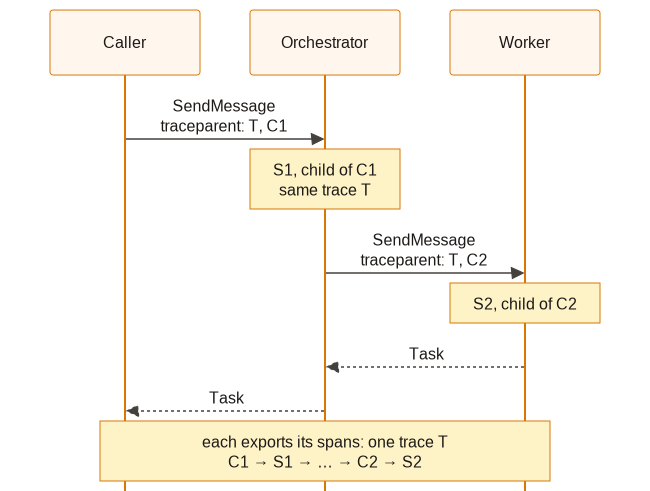
With Telemetry: nothing to write
With the otel feature and a tracing-opentelemetry layer recording — what
Telemetry installs — a well-formed inbound traceparent is the SERVER
span's remote parent, and every outgoing call's traceparent names the call's
own CLIENT span, so the agent called becomes its child: from inside an
executor, under the executor's span; from anywhere else, under whatever span
is current. A downstream agent's trace therefore points at a parent your
backend has. No propagation code is needed in either agent: the
Langfuse measurement shows a seven-span chain
across two agents built this way.
ClientBuilder::with_trace_propagation(false) turns sending off for a client
calling agents that should not learn your trace ids. It applies to the
transports the client builds for JSON-RPC, HTTP+JSON and gRPC, not to one
supplied through with_custom_transport. Such a transport names the
rpc.system.name its calls' spans carry through Transport::rpc_system
(jsonrpc for WebSocketTransport, slimrpc for SlimRpcTransport); the
span keeps the agent from the card either way.
Without a recording layer
Without the otel feature the spans are ordinary tracing spans, and the id
sent onward is minted for the hop. The server parses an inbound
traceparent, advances the span, and hands it to the executor, which can
send it on explicitly:
#![allow(unused)]
fn main() {
use a2a_protocol_client::{A2aClient, ClientResult, CurrentTrace};
use a2a_protocol_server::RequestContext;
use a2a_protocol_types::params::MessageSendParams;
async fn delegate(
    ctx: &RequestContext,
    downstream: &A2aClient,
    params: MessageSendParams,
) -> ClientResult<()> {
// `ctx.trace_context()` names *this* hop's span, so sending it verbatim
// makes the callee a child of this agent.
if let Some(trace) = ctx.trace_context().cloned() {
    CurrentTrace::scope(trace, async {
        downstream.send_message(params).await
    })
    .await?;
}
Ok(())
}
}
Without a recording tracing-opentelemetry layer, None means the caller
sent no traceparent, or sent one the SDK refused; under
InboundTracePolicy::Drop it is None for every call, even one with a valid
header. With a recording layer the value names this server's own recorded
span, a new root when the caller sent no traceparent. The SDK never repairs
a header: a malformed one is dropped, because attaching work to a guessed-at
trace is a wrong answer where a missing trace is only an absent one.
On the calling side, add TracePropagationInterceptor to the client and it
writes the ambient CurrentTrace onto every request over JSON-RPC, REST or
gRPC. An agent that is the first hop starts one with
CurrentTrace::start_root(). With both a recording layer and the interceptor,
a CurrentTrace scope is the client span's parent when no recorded span is
current.
WebSocket
Not over the websocket transport, which has no per-request header channel —
it carries headers only on the HTTP upgrade, and a traceparent fixed there
would report every request on the connection as one span, which W3C §3.4
forbids. The interceptor is silently ineffective on an established WebSocket
connection; the transport warns once per connection when it drops one. Send
traced calls over one of the other three. On the server, for the same reason,
a WebSocket call's span is not a child of the upgrade request's
traceparent: each call is a root span of its own, with a span link to the
upgrade's trace (under InboundTracePolicy::Continue).
Trusting the caller's trace
The inbound traceparent is read while the CallContext is built, which is
before your interceptors run — so on a public endpoint the peer choosing the
trace-id and the sampling bit has not been authenticated yet. W3C §7.2 names
what that allows: forged trace-id collisions that make the data unusable,
and an anonymous caller deciding what your tracing vendor bills you for. A
front gate sets
RequestHandlerBuilder::with_inbound_trace_policy(InboundTracePolicy::Restart)
to mint its own ids (§3.4's "Restart trace"), or Drop to refuse to trace an
unauthenticated request at all.
InboundTracePolicy | The SERVER span | Use it for |
|---|---|---|
Continue (default) | Joins the caller's trace: same trace-id, a fresh span | A trusted mesh; the reason A2A delegation chains are readable end to end |
Restart | A new root: new trace-id and parent-id, trace-flags reset, tracestate dropped | A front gate: this hop and everything below it stay correlated, but the caller chooses nothing |
Drop | No span at all, and ctx.trace_context() is None; the call's metric is still recorded | A front gate where the tracing bill is what is being protected |
The agent card's span follows the same policy.
Baggage, opt-in by key
W3C Baggage crosses the A2A wire only where an operator says so, on each side
separately (audit C-10). Baggage is a data channel to whoever the next hop is,
and an A2A peer is often another organisation's agent: forwarding every entry
would hand it whatever an upstream service put there (user.id, tenant, a
session id). So both sides default to BaggagePolicy::Off, and name the keys
that may cross:
use a2a_protocol_client::{BaggagePolicy, ClientBuilder};
use a2a_protocol_server::RequestHandlerBuilder;
struct Agent;
a2a_protocol_server::agent_executor!(Agent, |_ctx, _queue| async { Ok(()) });
fn main() -> Result<(), Box<dyn std::error::Error>> {
let (url, executor) = ("http://agent.example:9000", Agent);

// Sending: the call span's baggage, only these keys.
let client = ClientBuilder::new(url)
    .with_baggage_propagation(BaggagePolicy::keys(["deploy", "experiment"]))
    .build()?;

// Receiving: the caller's baggage joins the call's context (and so the
// executor's, and the calls it makes), only these keys, under `Continue`.
let handler = RequestHandlerBuilder::new(executor)
    .with_baggage_propagation(BaggagePolicy::keys(["deploy"]))
    .build()?;
drop((client, handler));
Ok(())
}
BaggagePolicy::All forwards every entry, for a chain wholly inside one trust
boundary. Either way the W3C limits apply (§3.3.2): at most 64 whole members
and 8192 bytes; a received header over 8192 bytes is dropped whole, a
malformed member is skipped. Received baggage is read only under
InboundTracePolicy::Continue (Restart and Drop discard it with the
caller's trace), and is never made a metric attribute. Values are
percent-decoded on the way in and encoded on the way out; a member's
properties (;ttl=30) are kept. A baggage header the caller set on the
request itself is never replaced. Sending needs the otel feature, a
recording tracing-opentelemetry layer, and a binding with per-request
headers (JSON-RPC, HTTP+JSON, gRPC); WebSocket carries none.
OTEL_PROPAGATORS decides which of the two is carried, on the client when
its ClientConfig is made and on the server when the handler is built
(default tracecontext,baggage): without tracecontext a client writes no
traceparent of its own and a server does not continue the caller's trace
(Continue acts as Restart); without baggage neither reads nor writes
baggage; none turns off both. A name neither carries (b3, jaeger,
xray) is warned about and ignored, and a list of only such names gets the
default. with_propagators(Propagators) sets it in code, on either side.
What is not done
Nothing interprets tracestate — the SDK adds no vendor entry of its own
and reads nobody else's; it only truncates whole entries when a list exceeds
the documented 4096-character or 32-member cap (W3C §3.3.1.5). The SDK adds no
sampler of its own: with Telemetry, sampling is the OpenTelemetry SDK's
(OTEL_TRACES_SAMPLER, default parentbased_always_on), and under that
parent-based default and Continue the caller's sampled flag decides, which
is why a front gate uses Restart or Drop. Each hop's a2a.task.id is on
its own invoke_agent span; nothing links one hop's task id to the next
hop's. The agent-card fetch sends no traceparent, so on each side it is a
trace of its own.
Across languages
Because traceparent is a wire format rather than a Rust type, agents in
other languages should join the same trace; that has not been run against the
Python, JavaScript, Go and Java agents under itk/ (the Integration Test
Kit). It was run between this repository's own processes, 2026-10-26: the
a2a CLI's SendMessage span and the server's spans carried one trace id.