Resubscribing and resuming
This page covers getting a stream back: resubscribing to a task, resuming
from the last event you saw with Last-Event-ID, and why the last frame of a
stream always agrees with the store.
Resubscribing
If a stream disconnects, re-subscribe to an existing task:
#![allow(unused)]
fn main() {
use a2a_protocol_sdk::prelude::*;
async fn f(client: A2aClient) {
let mut stream = client
    .subscribe_to_task("task-abc")
    .await
    .expect("resubscribe");
}
}
The server creates a new broadcast subscriber and immediately emits a Task
snapshot as the first event, allowing the client to recover the current state.
Multiple SSE connections can be active simultaneously for the same task — each
receives all events published after it subscribes. A reader that falls behind
by more than the queue capacity catches up from the task's event log; only when
the log cannot supply what it missed does its stream end with a streamLagged
error frame. Either way it never blocks other readers or the writer; after a
streamLagged, resubscribe with subscribe_to_task_from to continue.
Terminal tasks: Subscribing to a task in a terminal state (
Completed,Failed,Canceled,Rejected) returns anUnsupportedOperationerror immediately. No stream is opened: on JSON-RPC the answer is a plainapplication/jsonerror response (see Errors on the wire).
Parked tasks: Subscribing to a task that is waiting in
INPUT_REQUIREDorAUTH_REQUIREDkeeps the stream open. By default the server sets no idle bound (HandlerLimits::with_subscribe_max_idlesets one). When the next turn starts, the stream carries that turn's events, replayed from the event log if the turn ran before the stream noticed it.
Resuming from where you left off
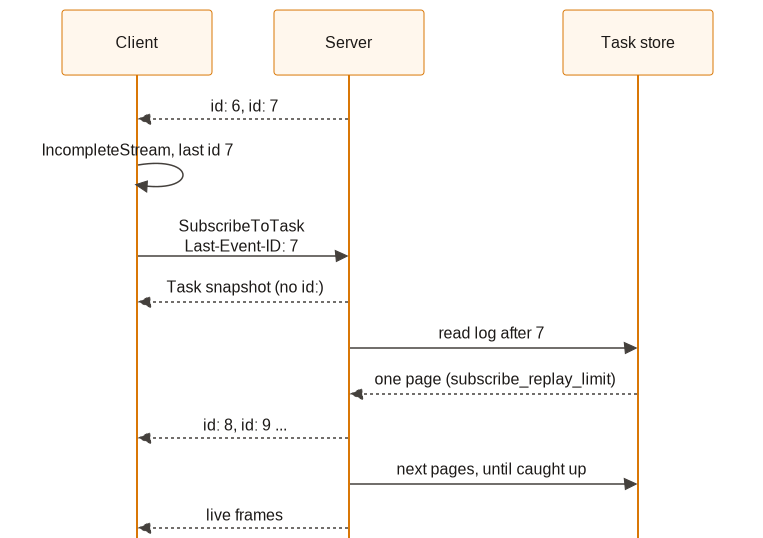
With a2a-protocol-client, a broken stream tells you: next() yields
ClientError::IncompleteStream when the body ends before the stream's final
event, carrying the last id: received (also available as
EventStream::last_event_id()). Pass it to
client.subscribe_to_task_from(task_id, id), which sends it as
Last-Event-ID on JSON-RPC and HTTP+JSON. The wire contract underneath:
A snapshot tells you where the task is, not what happened while you were disconnected. An agent that emitted three progress updates during the outage folds them into one state, and a client polling or resubscribing sees one.
Every frame carrying an event the agent emitted therefore also carries an SSE
id:, which is that event's position in the task's event log:
id: 7
event: message
data: {"statusUpdate":{"taskId":"task-abc", ...}}
Send the last one you saw back as Last-Event-ID on the resubscribe, and the
server replays the log from exactly there — after the snapshot, before the
live stream:
POST /tasks/task-abc:subscribe
Last-Event-ID: 7
Details worth knowing:
- The offset is exclusive.
Last-Event-ID: 7returns 8 onward.0asks for the whole history. - Frames without an
id:are not in the log. TheTasksnapshot and the terminal frame the server rebuilds from stored state are server-synthesized rather than agent-emitted, so they carry no position and do not move your offset. - Each read of the log is bounded by
HandlerLimits::subscribe_replay_limit(default 1,000). A longer replay is read a page at a time, each page delivered before the next is read, soLast-Event-ID: 0delivers the whole retained history on one connection. Memory stays bounded by the limit, not by the history. - It needs a store that keeps a log. Every store this crate ships does
(
TaskStore::supports_event_log). A custom store that does not gets the snapshot and the live stream, which is the behaviour from before resumption existed — the header is ignored rather than refused. - A malformed
Last-Event-IDis ignored, not rejected, so echoing back an id from an unrelated stream costs you a replay, not the connection.
The terminal frame is the stored one
Every frame but the last is broadcast as soon as the agent emits it, without
waiting for the store. The frame carrying a terminal state is held until the
server has persisted it (bounded by the queue's write timeout, 5 s by
default), and it goes out as the store ruled: the agent's own frame when it
persisted, or the state the store already holds when another writer finished
the task first — a CancelTask handled by another replica, typically. The
log records the same frame at that position, so a resumed stream ends the way
the live one did, and a GetTask made after reading the terminal frame
agrees with it.
When the store's write fails, the failure does not say whether it was applied
(an acknowledgement is lost as easily as a request), so the server reads the
task back. If it is stored in the state the frame names, the write landed and
the frame goes out. Otherwise — the write was refused, the read shows another
state, the store cannot be read, no answer came within the timeout, or the
processor had stopped — the stream ends with an UNAVAILABLE error, not a
terminal frame: the client is never told a task finished that the store does
not record as finished, and GetTask says what the store holds. Nothing is
logged or pushed for an ending the store lacks; if its write lands later it is
logged and pushed then, so the log, the webhooks and GetTask agree with one
another even when the stream that gave up waiting does not carry it.
HandlerLimits::with_terminal_confirmation(TerminalConfirmation::BestEffort)
restores the earlier behaviour, in which a frame the store had not confirmed
went out as the agent wrote it.
The trade is latency on that one frame: it now waits for the store write, and for the processing of any events queued ahead of it.